
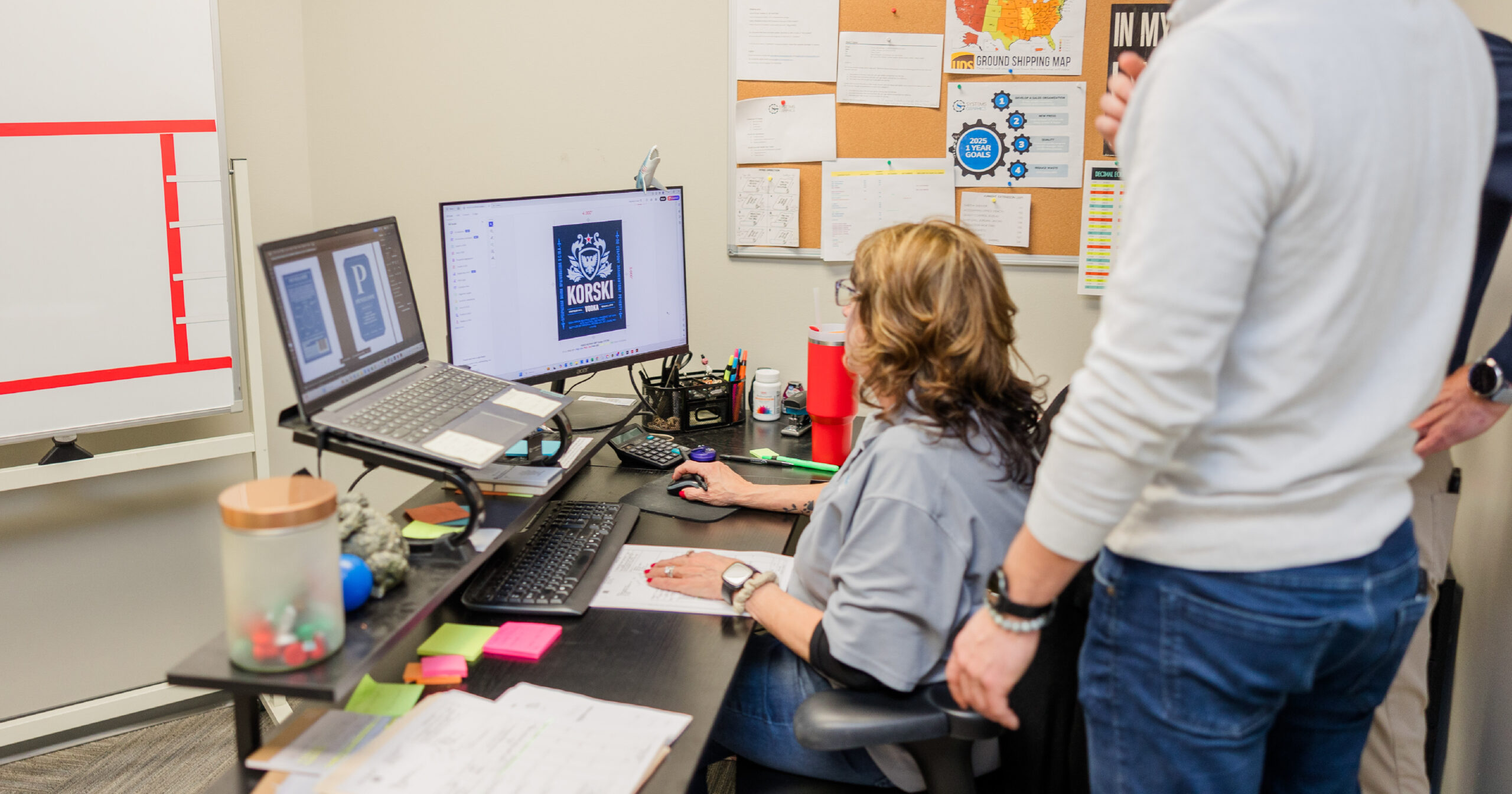
New product labels touch a lot of hands and systems, so it’s easy for timelines and budgets to slip. The fastest, lowest‑cost path is a reliable one: align with production and compliance experts up front, design for the container and application method you’ll actually use, and commit to a disciplined proof cycle. This approach prevents rework, shortens make‑ready, and protects your budget from rush fees and scrapped inventory.
Systems Graphics helps you set those guardrails early so the artwork you approve is the artwork that runs. Reach out for a step-by-step design consultation today.
Why Early Consultation Shortens the Path to Printing
The fastest, least expensive projects are the ones that move forward instead of in circles. Early in the process, align creative goals with production constraints and regulatory requirements.
In week one, align on:
- Container & application: Bottle shape, label panel, curvature, taper, and whether the label is hand-applied or machine-applied.
- Regulatory framework: Which panels are required, such as Nutrition Facts on food and beverage items, along with any multilingual needs.
- Environment & performance: Exposure to moisture, UV, chemicals, sterilization, cold chain, or abrasion.
- Operations: Forecasted volumes, target timelines, budget ranges, and reorder strategy (including whether vendor-managed inventory makes sense).
An initial consultation with Systems Graphics sets these parameters, provides guidelines for your exact container, and clarifies material options so design choices don’t create rework in the future.
Mockups and Dielines
Mockups translate creative pieces onto the actual container. Designing against the correct dieline and substrate will show you how the information, color, and barcodes behave on the real surface. This step gives you a chance to confirm what a shopper’s eye will see at a glance and what scanners will be able to pick up at speed.
Best Practices:
- Work from precise dielines: Request a template for the exact container, including bleed, safe zones, perforations, and any tamper features.
- Test on the container early: Quick prints on similar material expose curvature, glare, wrap distortion, and edge conflicts.
- Plan for data: Reserve space for lot/batch, date codes, serialization, or QR codes, plus human‑readable fields.
- Design for substrate: Remember that paper, film, and foil shift color and contrast. Preview finishes (matte, gloss, soft‑touch) when choosing palettes.
Mock‑ups are successful when they confirm real‑world behavior, not just screen‑level aesthetics.
Typography and Layout
Type choices and layout rules are the backbone of readable, audit-ready labels. Small details like stroke weight and spacing have a bigger-than-you’d-expect impact on line performance and customer perception. Treat legibility as a requirement, not a preference.
Best Practices:
- Respect minimum sizes: Set regulatory copy at sizes that hold on your substrate and print method. Avoid condensed faces for microtype.
- Tune for glare and distance: Use clean sans‑serifs for body copy. Adjust letter‑ and line‑spacing for glossy surfaces and retail viewing distances.
- Protect small elements: Avoid ultra‑thin strokes and delicate serifs in reversed type. Confirm barcode quiet zones.
- Place it once, place it right: Orient barcodes for your scanners and keep tamper cues near closures.
Clear type and disciplined placement reduce redlines later and keep production moving.
Press-Ready File Preparation
Pre-press files are how creative choices become repeatable outcomes. The preflight locks in color definitions, layers, and link integrity so it matches what the press can actually produce. A clear handoff process will save time in press and prevent late edits.
Best Practices:
- Enforce file standards: Vector logos/line art, linked high‑resolution images, and no stray RGB assets in print areas.
- Be explicit about color: Define CMYK and spot colors, specify Pantone targets, and include LAB values if applicable.
- Organize layers by function: Separate dieline, varnish/lamination, white ink, cold foil, and emboss/deboss as named spot colors.
- Engineer variable data: Specify data source, field lengths, fonts, check digits, and verification method (up to 100% camera inspection when required).
- Package the job: Deliver an approved PDF/X for sign‑off, and include a change log tied to legal/regulatory approvals and version numbers.
Good preflight narrows uncertainty. It’s always a good idea to check with your production expert about what works best for their process.
Choosing Materials and Construction
Labels need to hold up to real-world conditions. To do that, you need to choose the materials and components carefully:
- Facestock carries the print and defines much of the look and durability of the label.
- Adhesives determine whether the label will stay put on glass, PET, or HDPE at specific temperatures.
- Liners must release clearly while supporting high-speed die cutting and application.
You’ll choose each layer based on what the product will face in storage and on store shelves. Getting the right combination is the difference between a label that looks good on day one and one that still looks good after shipping, storage, and use.
Proof Cycles
Proofing should happen in stages, so each approval protects the next stage. These stages should include:
- First proof: Lock in the copy, dieline fit, barcodes, and legal text. This is where any edits to the text should end.
- Second proof: Evaluate the brand color on the intended substrate and finish, and document how the inks and metallics work.
Approvals should tie to exact file versions and a short change log so legal and QA know precisely what was signed off.
First Production Run
If everything is done correctly, the first production run should be a confirmation exercise, not an experiment. The press crew will receive the targets, then get everything set up, checking the registration at speed and going through an inspection process to align with QA.
Once the labels are printed and packed, the loop is closed by retaining samples, a master spec, and reorder points. A clean handover will make the second run even faster than the first, and that’s where your savings (on both time and money) really start to shine.
Get to Market Faster With a Clean Label Production Journey
Moving from sketches to durable labels doesn’t take heroics. It takes a considered, measurable, and repeatable process. Systems Graphics brings GMP-aware workflows and flexographic expertise, along with material science, under one roof. We align brand intent, operational realities, and regulatory needs from day one for smoother production runs.
Eliminate guesswork from your first production run. Contact Systems Graphics for a step-by-step design consultation—and ensure your labels are right the first time.